A website costs on average between 1,500 and 5,000 francs for a professional showcase site, and between 5,000 and 20,000 francs or more for a custom online store, plus a few hundred francs a year in recurring costs (domain name, hosting, maintenance). The price comes down to three things above all: who builds the site, how custom it is, and how many pages and features you genuinely need. You can also build it yourself for a few dozen francs a month, but what you save in money you pay back in time, and often in results.
What follows answers the real questions that freelancers, small businesses and shop owners in Switzerland and France ask before requesting a quote: the actual price ranges, what drives the cost up, the difference between an agency, a freelancer and a do-it-yourself solution, the costs everyone forgets, and how to set a budget without getting burned. It is written to help you understand the ground before you sign, not to sell you the most expensive option.
How much does a website cost on average?
On average, a professional website costs between 1,500 and 5,000 francs for a showcase site, and climbs past 5,000 francs as soon as you add online selling or custom features. But an average means very little until you know what sits behind it.

To give you concrete reference points, here is how budgets break down across the market. A do-it-yourself solution on a turnkey tool runs to a few hundred francs a year, all in. A showcase site handed to a freelancer often starts around 1,000 to 1,500 francs and climbs to 4,000 or 5,000 depending on the care that goes into it. An agency usually charges from 2,500 francs for a showcase site and can reach 10,000 or more for an ambitious project. An online store rarely starts below 3,000 francs and can pass 20,000 when the catalogue is complex and the design fully bespoke.
These gaps make sense. The same words, “a website”, cover both a single page thrown together over a weekend and a platform built over several weeks by someone who does this for a living. When you compare two quotes, you are almost never comparing the same thing: one includes custom design, written content, basic search visibility and support, while the other simply drops in a ready-made template and fills it out. The right price is not the lowest one, it is the one that matches what your business actually needs to bring in clients.
What makes the price of a website vary?
The price of a website varies according to four main levers: the number of pages, how custom the design is, the technical features required, and the quality of the content you provide. Each of these can double or triple the bill, independently of the others.

The first lever is the size of the site. A single well-made page costs far less than a fifteen-page site with detailed sections, a blog and service pages. The more pages there are to design, write and build, the more working hours the project takes, and hours are what you are really paying for.
The second lever is the design. Picking an existing template and adapting it costs a fraction of what a design built specifically for you costs, one drawn from your brand, your colours and the way you speak to your clients. A custom design takes hours of thinking, mockups and back-and-forth, but it is what stops your site from looking like thousands of others. It is often the difference between a site people forget and a site people remember.
The third lever is the features. A simple contact form costs almost nothing. A booking system, a client area, online payment, a connection to your management software or a site available in several languages is another story. Every feature you add takes development, testing and maintenance. The right question is not “what could we add”, but “what genuinely helps you sell or save time”.
The fourth lever, which is almost always underestimated, is the content. The text, the photos, the structure of each page all have value. A site whose content arrives clean and ready moves fast. A site where every page has to be written, every image retouched and every argument invented takes far longer, and therefore costs more. If you want to keep your budget under control, preparing your content up front is one of the best levers you have.
How much does a showcase website cost?
A professional showcase site costs between 1,500 and 5,000 francs when built by a freelancer or a small studio, and can pass 8,000 francs at an agency for a very polished project. It is the most common type of site for a freelancer, a craftsperson or a small business that wants to present its work and be found on Google.

A showcase website exists to present who you are, what you offer and how to reach you. It does not sell directly online, but it works for you around the clock: it reassures the clients looking for you, it answers questions before the first phone call, and it puts you in the search results when someone looks for your trade in your area. For many businesses it is the most profitable sales tool there is, because a single client won through the site often covers a good part of its cost.
What drives the price of a showcase site is mainly the number of pages and the level of finish. A five-page site with a clean design, clear content and basic search visibility sits at the lower end of the range. As soon as you add a blog to attract traffic, detailed pages for each service, careful animation and serious work on search visibility, the price naturally rises. At that level you are not just paying for a site that exists, you are paying for a site that gets found and makes people want to contact you. The difference between the two is invisible on launch day; it shows up in the months that follow, when the phone rings or stays silent.
How much does an e-commerce website cost?
An online store costs between 3,000 and 8,000 francs for a standard project on an established platform, and between 8,000 and 20,000 francs or more for a fully custom e-commerce site. The range is wide because a store hides far more work than a showcase site.

When you sell online, displaying products is not enough. You have to manage a catalogue, variants, stock, a cart, secure payment, shipping, taxes, confirmation emails and order tracking. Each of these takes work and technical decisions. That is why an online store costs more than a simple presentation site, even with the same number of visible pages.
You broadly have two paths. The first is to build your store on a turnkey platform: the monthly subscription and transaction fees make the start affordable, but you stay inside the tool’s limits and you keep paying every month for as long as the store runs. The second is to have a custom store built: the upfront investment is higher, but the result is yours, it looks like no other, and it can grow freely with your business. The right choice depends on your catalogue, your volumes and the image you want to project. A brand that wants to stand out and plans to sell seriously often gains from investing in bespoke work; a shop owner testing a first product is better off starting simple.
Should you use an agency, a freelancer or do it yourself?
Doing it yourself costs the least in money but the most in time, a freelancer offers the best value for most freelancers and small businesses, and an agency makes sense for complex or strategic projects. Each of the three routes leads to a website, but not to the same result, nor the same demand on your time.

Building your own site with a turnkey tool is tempting, and for some cases it’s enough. You pay a few dozen francs a month and you keep control of everything. The trap is time: learning the tool, writing the text, choosing the images, understanding search visibility and sorting out the technical details takes dozens of hours, hours you aren’t spending on your actual trade. Some AI-powered website builders can speed up the design and writing, but the result still needs careful revision to match your brand. And what these tools produce often looks like a lot of other sites. For a business starting out on a tight budget, it’s an honest starting point. For a business that wants to be taken seriously, it rarely stays enough for long.
For most freelancers and small businesses, a freelancer is the best compromise. You work directly with the person who builds your site, without the overhead of a large agency, and you get bespoke work suited to your business. That is usually where the best balance between what you pay and what you get sits. You can see what that kind of work looks like in my portfolio.
An agency makes sense when the project becomes large or strategic: several languages, complex integrations, a brand identity to build from scratch, a team to coordinate. You are then paying for a full structure, with several specialists, and that cost makes sense when the stakes match it. For a classic showcase site, on the other hand, going through a large agency often means paying for overhead that does not show up in the final result. If you are unsure which option fits your case, that is exactly the kind of question we can clear up before you start a project.
What are the recurring costs of a website?
Beyond the cost of building it, a website costs between 200 and 800 francs a year in recurring fees: the domain name, hosting, the security certificate and maintenance. These costs are unavoidable, and ignoring them is one of the most common mistakes when setting a budget.

The domain name is your address on the internet. It usually costs between 10 and 50 francs a year depending on the extension you choose. It is little, but it has to be renewed every year, and losing it by oversight can be very painful, because someone else can then take it.
Hosting is the space where your site lives so it stays reachable at all times. Expect anything from a few dozen francs a year for a small showcase site to several hundred for a high-traffic site or an online store. Decent hosting is not a luxury: it is what makes your site load fast and stay online, and speed matters as much to your visitors as it does to Google.
The security certificate, which shows the little padlock and turns your site into a secure address, is now essential. It is often included with hosting, but not always, so check. A site without the padlock scares visitors off and gets penalised in the search results.
Maintenance, finally, is the line people drop most readily and regret neglecting most. A site is not a frozen object: it needs updating, its content needs backing up, small bugs need fixing and it has to keep up with technical changes. Depending on whether you handle this yourself or take a support contract, expect anything from a few hundred francs a year to a monthly plan. A site left without upkeep eventually breaks, gets hacked or starts showing errors, and an emergency fix almost always costs more than steady maintenance.
Why can a cheap website cost more in the end?
A cheap website often costs more in the end because it brings in no clients, because it has to be rebuilt after a year or two, and because the time lost fixing it outweighs the initial saving. The purchase price is only part of the real cost of a site.
The logic is easy to grasp once you step back. A site exists for a reason: to be found, to inspire trust and to turn a visitor into a client. If it fails on those three points, its price no longer matters, it earns you nothing. And a site thrown together on a generic template, with no search work and no thought about what your clients are looking for, almost always fails. It is online, but nobody finds it, and those who do are not convinced. You paid for a site and you ended up with an expense.
Then there is the question of how long it lasts. A site built on shaky foundations ages badly. After a year or two you often have to start over, which means paying for a redesign on top of what you already spent. A site built well from the start, by contrast, holds up for several years and evolves instead of being thrown away.
None of this means you should aim for the most expensive option. It means you should aim for the right one: a site that matches your business, that is built to bring in clients and made to last. The real saving is not measured by the size of the quote, it is measured by what the site earns you over several years. A slightly more expensive site that brings in clients regularly is far cheaper than a cheap site that does nothing.
How do you set the right budget for a website?
To set the right budget, start from what the site has to achieve for your business, not from the amount you want to spend. A website is a commercial investment: the real question is not “how much does it cost”, but “how much can it earn me”.
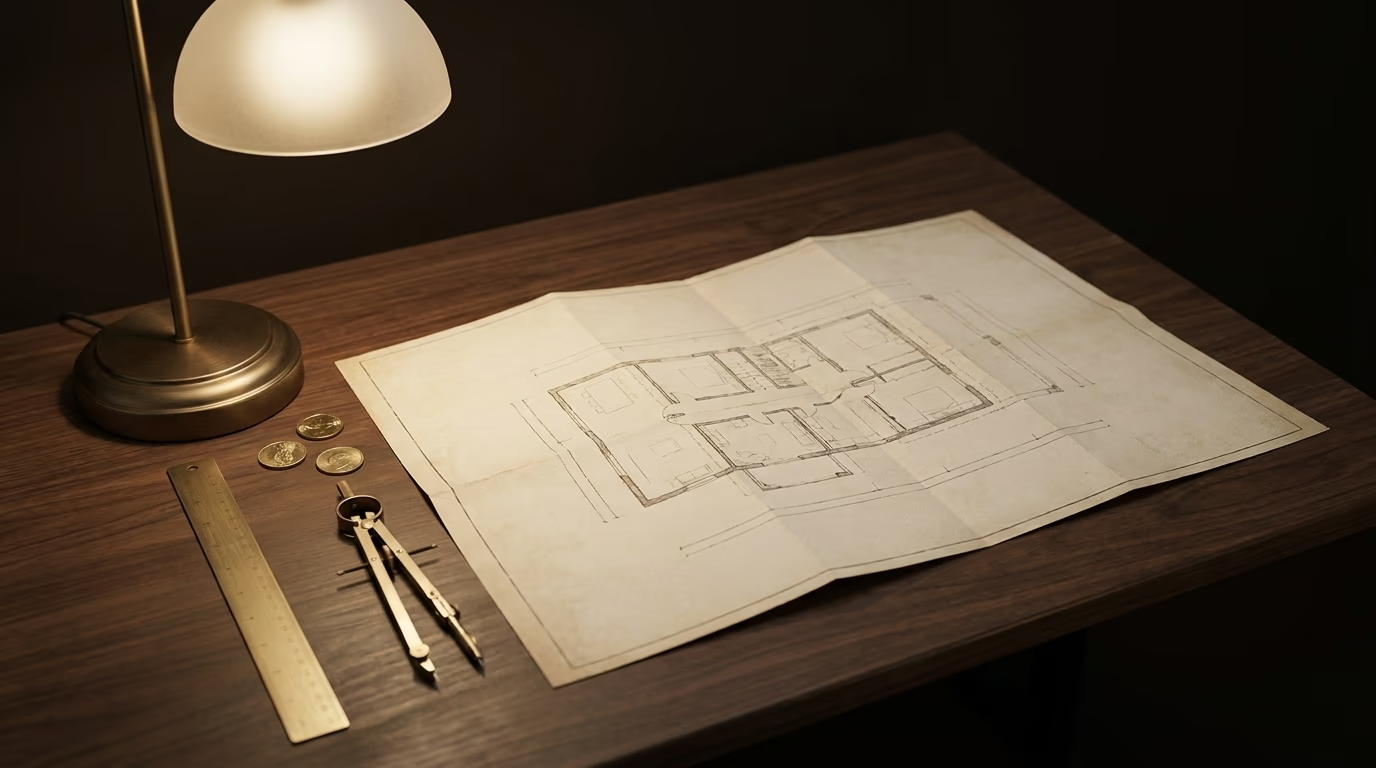
Start by getting clear on the goal. Do you want to be found on Google by clients in your area? To present your work in order to land bigger contracts? To sell directly online? To take appointments automatically? Each goal calls for a different type of site, and therefore a different budget. A clear goal saves you from paying for useless features and from neglecting the ones that genuinely matter. If you are not yet sure your business needs a website at all, the reasons why you need a website will help you decide before setting a budget.
Next, think in terms of return on investment rather than expense. If a client won through your site is worth several hundred or several thousand francs to your business, a site costing a few thousand francs that brings in a handful a year pays for itself quickly. Skimping a few hundred francs on a site that brings in nobody, on the other hand, is not a saving, it is a loss. Understanding how to create a website that genuinely serves your business helps you know where to put your money and where not to.
Finally, plan for the recurring budget from the start, and factor search visibility into your thinking. A site that never shows up in the search results is no use to anyone, so it is better to plan, from the project itself, the work needed to rank on Google rather than discovering it too late. Always ask for a detailed quote that spells out what is included: design, content, basic search visibility, training, maintenance. A clear quote lets you compare like with like and choose with your eyes open. And if you want to talk it through for your specific case, we can do that before we start a project together.